Corporate leg of optimism is showing up on two different sides:
1. Dividend payments,
2. Share buybacks.
Two added together are signalling good performance in the short term accompanied with “sustainability demand” for the long term to invest in projects, which will increase NPV and therefore shareholders’ wealth.
Thursday, 15 April 2010
Tuesday, 30 March 2010
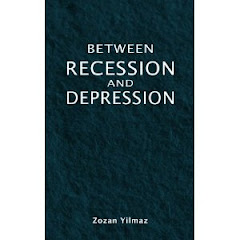
BETWEEN RECESSION AND DEPRESSION
"Between Recession and Depression" is the title of my new book about the current economic crisis, which is now available to buy in the market.
If you wish to purchase a copy, you can do so from Amazon.com, Amazon.co.uk or Arima Publishing.
I am quite excited as this is my first publication. When you have had a chance to read the book I would welcome any feedback or comments via email. Alternatively you can review on the Amazon web site.
If you wish to purchase a copy, you can do so from Amazon.com, Amazon.co.uk or Arima Publishing.
I am quite excited as this is my first publication. When you have had a chance to read the book I would welcome any feedback or comments via email. Alternatively you can review on the Amazon web site.


Thursday, 18 March 2010
ONE YEAR ON
It has been a year since I started to write in my blog.
If there is a need to find one single word to describe the last one year of the economics, that would be “speed”. It sometimes felt as if we were travelling at 300thousand kilometres per second.
Just remember the change in Davos World Economic Forum from 2009 to 2010. “We can not predict anything” was the theme brought by CEOs in 2009 whereas in 2010 a wide variety of social subjects were being discussed with a big relief that the worst for global economy is over.
The Economist had made a point about 2008, 2009, and 2010 by first one being financial meltdown, second being government intervention, and predicting third to be exit from expansionary policies. 2010 can also be evolutionary in a “kaizen” sense.
If there is a need to find one single word to describe the last one year of the economics, that would be “speed”. It sometimes felt as if we were travelling at 300thousand kilometres per second.
Just remember the change in Davos World Economic Forum from 2009 to 2010. “We can not predict anything” was the theme brought by CEOs in 2009 whereas in 2010 a wide variety of social subjects were being discussed with a big relief that the worst for global economy is over.
The Economist had made a point about 2008, 2009, and 2010 by first one being financial meltdown, second being government intervention, and predicting third to be exit from expansionary policies. 2010 can also be evolutionary in a “kaizen” sense.
Saturday, 6 March 2010
NO MAN IS AN ISLAND
No man is an island,
Entire of itself.
Each is a piece of the continent,
A part of the main.
If a clod be washed away by the sea,
Europe is the less.
As well as if a promontory were.
As well as if a manner of thine own
Or of thine friend's were.
Each man's death diminishes me,
For I am involved in mankind.
Therefore, send not to know
For whom the bell tolls,
It tolls for thee. “
Note: Thee = you
Thine= your
Entire of itself.
Each is a piece of the continent,
A part of the main.
If a clod be washed away by the sea,
Europe is the less.
As well as if a promontory were.
As well as if a manner of thine own
Or of thine friend's were.
Each man's death diminishes me,
For I am involved in mankind.
Therefore, send not to know
For whom the bell tolls,
It tolls for thee. “
Note: Thee = you
Thine= your
Tuesday, 9 February 2010
US CREDIT RATING
Moodys's warned last week over US's credit rating that triple A might be under pressure if growth was not robust. Exit from expansionary policies and worries of what will happen with the bubble inside the bubble are the main concerns.
Thursday, 4 February 2010
SHAPE OF RECESSION
There were many discussions on which letter of the alphabet the recession would end up with:
W: Double dip, two consecutive business cycles
V: Single dip
L: Economy going down and staying there for long.
I think, there is a need for a new letter to show that economy is balancing at lower level of income (macro wise). "F" may be. We can think it in terms of Cartesian coordinates: x the horizontal axis, y the vertical axis and the top horizontal line (x1) of letter F as the level of income before recession and the below horizontal line (x2) as the level after the recession.
W: Double dip, two consecutive business cycles
V: Single dip
L: Economy going down and staying there for long.
I think, there is a need for a new letter to show that economy is balancing at lower level of income (macro wise). "F" may be. We can think it in terms of Cartesian coordinates: x the horizontal axis, y the vertical axis and the top horizontal line (x1) of letter F as the level of income before recession and the below horizontal line (x2) as the level after the recession.
Friday, 29 January 2010
DAVOS WORLD ECONOMIC FORUM
The forum is taking place since 27th of January and will finish on the 31st.
It is a good mix of 900 CEOs, government representatives, media, academic professionals, NGOs.
This year there are many different topics on the agenda one of which is "Directing Avatar" -- Conversation with James Cameron.
Interesting to see it among the Economic Forum topics.
Many others with social focus are population growth, social networks, life on other planets, rethinking philanthropy, enrichment through music, economics of happiness.
It is a good mix of 900 CEOs, government representatives, media, academic professionals, NGOs.
This year there are many different topics on the agenda one of which is "Directing Avatar" -- Conversation with James Cameron.
Interesting to see it among the Economic Forum topics.
Many others with social focus are population growth, social networks, life on other planets, rethinking philanthropy, enrichment through music, economics of happiness.
JAPANESE MIRACLES
Japan has been one of the miracle countries. On a land of nearly 80% of mountains unsuitable for agriculture they still managed to be the ninth largest producer of rice in the world, the main ingredient of their famous sushi. As an island being exposed to tsunamis, earthquakes they managed to build the houses, which can survive the earthquake at magnitude of 8.
Rank of number two in the league of global GDP, forth largest exporter and sixth largest importer plus enormous growth between 1960 and 1980 made the country a role model for the rest of the world in their management concepts such as kaizen (continuous improvement), just-in-time (production upon demand).
After their lost decade of 1990s, and a global world shaken by credit crunch, they are challenged again with an economy of deflation keeping the consumption low, weak earnings keeping investment low, government debt already with over 180% of GDP.
However, Japan managed to bring the exports, the only variable left to play with; in their favour in December 2009 at a level of ¥5.41trillion ($59billion). The country's exports are growing again after 15 months of consecutive fall. Yes, they are very below their peaks considering the fact that it was ¥12.7trillion ($113billion) in November 2007. What matters though is to gain the momentum of growth again.
Can Japan be heading to a new miracle of achieving good growth of GDP despite the challenges of depressed consumption, investment items and a government spending, which is restricted with a cumulatively high debt level and credit rating constraints?
The answer can be “yes”.
Rank of number two in the league of global GDP, forth largest exporter and sixth largest importer plus enormous growth between 1960 and 1980 made the country a role model for the rest of the world in their management concepts such as kaizen (continuous improvement), just-in-time (production upon demand).
After their lost decade of 1990s, and a global world shaken by credit crunch, they are challenged again with an economy of deflation keeping the consumption low, weak earnings keeping investment low, government debt already with over 180% of GDP.
However, Japan managed to bring the exports, the only variable left to play with; in their favour in December 2009 at a level of ¥5.41trillion ($59billion). The country's exports are growing again after 15 months of consecutive fall. Yes, they are very below their peaks considering the fact that it was ¥12.7trillion ($113billion) in November 2007. What matters though is to gain the momentum of growth again.
Can Japan be heading to a new miracle of achieving good growth of GDP despite the challenges of depressed consumption, investment items and a government spending, which is restricted with a cumulatively high debt level and credit rating constraints?
The answer can be “yes”.
Friday, 22 January 2010
JAPANESE AIRLINES
One thing, which can only be seen as “the whole glass is empty” is bankruptcy. It can be quite nostalgic depending on how old the company is. Last year in UK the list of the big names included 100 years old Woolworths, 250 years old Wedgewood. The former being the choice of tight budget customers whereas the latter serving luxury looking customers. Both existed over many generations.
As we are going through 2010’s first month, a new huge one came up from Japanese Airlines, which is Asia’s biggest airline. This is the first bankruptcy of the industry at this scale during this recession. Japanese government’s announcement of protection of creditors provided a relief. And it is a re-reminder of weak earnings considering the liquid nature of the business model.
The reason/s why this is so important will be the subject of my new blog post.
As we are going through 2010’s first month, a new huge one came up from Japanese Airlines, which is Asia’s biggest airline. This is the first bankruptcy of the industry at this scale during this recession. Japanese government’s announcement of protection of creditors provided a relief. And it is a re-reminder of weak earnings considering the liquid nature of the business model.
The reason/s why this is so important will be the subject of my new blog post.
Saturday, 9 January 2010
THE FINANCIAL CRISIS INQUIRY COMMISSION
We are seeing United States initiative for investigations regarding the causes of the recent crisis. We have been discussing, reading about these since 2007 but the commission has put them in a more organized structure under 22 headings ranged from credit rating agencies, global imbalances, corporate governance, derivatives to securitisation.
On the positive side:
1. US determination to lead the exit is persistent
2. A rich mix will be available in hearings from head of top investment banks to regulators and independent experts.
On the question mark side:
Will it cause high public expectations or indifference?
On the positive side:
1. US determination to lead the exit is persistent
2. A rich mix will be available in hearings from head of top investment banks to regulators and independent experts.
On the question mark side:
Will it cause high public expectations or indifference?
Subscribe to:
Comments (Atom)